
Adipotide: Mechanisms of Vascular Targeted Adipose Disruption
Adipotide is an experimental approach to studying whether targeting fat’s blood supply can reduce white-fat tissue. Rather than acting directly on fat cells, the concept targets vessels that supply them. Findings in animals do not establish human outcomes, a dose, a safety threshold, or weight-loss use.
For U.S. researchers assessing preclinical evidence, the distinction matters: a change in animal body mass index is not proof of a clinical benefit. A product’s price or label also cannot establish that benefit. This review sets out what the research examines and what product details can and cannot show.
Key Takeaways
- The approach investigates disruption of white fat’s blood supply.
- Its intended vascular target is different from adipocytes themselves.
- Reported efficacy findings are preclinical, not established human outcomes.
- Product documentation and a listed research use do not show clinical suitability.
- The construct’s linked recognition and functional components make it a peptidomimetic.
A peptidomimetic is a synthetic construct designed to combine peptide-like recognition or activity with another functional component. The compound’s identity and linked domains explain that design.
What Is the Adipotide Research Peptide?
**Adipotide is a chimeric peptidomimetic also known as FTTP, and the name describes a compound, not a medical indication.** In the phrase adipotide research peptide FTTP, FTTP is an alternate name for the same experimental subject.
Stable identifiers are CAS number 859216-15-2, molecular formula C₁₁₁H₂₀₆N₃₆O₂₈S₂, and molecular weight 2,557.20 g/mol. These details help distinguish the compound in research records and product documentation.
The term peptidomimetic refers to a synthetic construct designed to combine peptide-like recognition or activity with another functional component. In this case, the design joins a targeting element to a functional payload.
That distinction matters when researchers compare a product label with a protocol. A matching name or molecular mass can help identify the intended material, but does not by itself confirm a particular batch’s contents or performance.
Nor does the name imply approval for human use. Adipotide remains a research subject, and its identifiers should not be confused with an established treatment or a clinical recommendation.
The linked domains clarify the proposed mechanism: one part is intended to recognize a target, while another is associated with cell disruption after internalization.
How Do Adipotide’s Two Domains Work?
Adipotide links a recognition motif to a payload rather than acting as one undifferentiated sequence. Its sequence is CKGGRAKDC-GG-D(KLAKLAK)₂, with distinct parts assigned different roles; those roles are proposed, not a guarantee of selectivity.
The prohibitin-targeting peptide is the cyclic motif CKGGRAKDC. The short GG linker joins it to the pro-apoptotic domain, D(KLAKLAK)₂. Researchers describe this two-part arrangement as a way to direct a payload toward selected cells.
The cyclic homing motif
CKGGRAKDC is the cyclic targeting motif. Its proposed role is recognition of prohibithin on white adipose tissue endothelial cells, the cells lining vessels associated with white fat.
Calling it a homing motif describes the intended design, not proof that the sequence reaches only one tissue. Binding, uptake, and biological response are separate questions that require experimental assessment.
The pro-apoptotic payload and linker
GG serves as the linker between the motif and the payload. The D(KLAKLAK)₂ domain is described as pro-apoptotic, meaning it is intended to promote apoptosis, a form of programmed cell death.
After internalization, the payload is described as disrupting mitochondrial membranes. The sequence alone does not guarantee a particular outcome, including selective cell death.
| Component | Sequence | Stated role | Where its action is described |
|---|---|---|---|
| Cyclic motif | CKGGRAKDC | Target recognition | Prohibithin on endothelial cells |
| Linker | GG | Joins motif and payload | Between the two domains |
| Payload | D(KLAKLAK)₂ | Promotes apoptosis | Mitochondrial membranes after internalization |
The proposed sequence of events starts with vascular recognition, followed by internalization and payload activity. Each step remains a subject for research rather than a guaranteed property of every experiment. The design points to the vascular cells it is intended to reach.
Why Does Adipotide Target White-Fat Vasculature?
The targeting rationale depends on prohibitin expression on endothelial cells supplying white fat. These cells line blood vessels, so the intended target is the vasculature rather than adipocytes themselves; that distinction is central to the design.
Prohibitin is described as the binding target on the surface of endothelial cells associated with white adipose tissue. The proposed route is to reach those cells through vessels supplying white adipose, then deliver the linked payload.
This differs from a compound designed to bind directly to fat cells. The rationale focuses on the blood supply supporting white adipose tissue, rather than on adipocytes as the initial target.
No quantitative binding-affinity value or off-target rate is stated. Without those measurements, readers cannot use a numerical threshold to compare binding strength or estimate how often other tissues may be affected.
Prohibithin-based selectivity is a proposed rationale, not proof that all other tissues are unaffected. Expression, access, uptake, and response may differ across tissues and experimental settings.
That caution also limits broad claims about the role of adipose tissue in a whole organism. A targeted mechanism in a model does not, by itself, establish how the approach would behave in people.
Animal experiments tested this vascular-targeting approach and reported findings that need to be read within each model’s limits.
What Have Rodent and Primate Studies Found?
The strongest described outcomes come from animal models, not human efficacy results. The findings include adipose tissue changes and metabolic measures, but they remain preclinical.
Kolonin et al. published foundational murine work in 2004 on targeted ablation of adipose tissue. That work supported a vascular-targeting proof of concept, not evidence of a human weight-loss effect.
The murine vascular-targeting proof of concept
In 2011, Barnhart et al. reported findings in obese Old World monkeys after a 28-day treatment period. MRI and dual-energy x-ray absorptiometry showed marked white adipose tissue reduction.
Findings and safety signals in obese monkeys
The monkey study also reported weight loss and improved insulin resistance. Those observations are often cited in an adipotide research peptide review, but they do not demonstrate human benefit or define a human dose.
Renal proximal tubule function changes were reported as predictable and reversible at experimentally determined optimal doses. That safety signal belongs to the reported monkey study and does not establish safety in people.
| Model and year | Intervention | Reported observation | Interpretive limit |
|---|---|---|---|
| Murine, 2004 | Targeted adipose tissue ablation | Vascular-targeting proof of concept | Not human efficacy evidence |
| Obese Old World monkeys, 2011 | Adipotide, 28 days | Reduced white fat, weight loss, improved insulin resistance | Animal findings; kidney changes also reported |
| Diet-induced obese mice, 2013 | Prohibithin-targeted nanoparticle carrying KLA | Effects reported for the nanoparticle intervention | Separate formulation, not adipotide |
The 2013 study tested a separate prohibithin-targeted nanoparticle carrying KLA in diet-induced obese mice. Its reported effects were not attributable to the adipotide bioconjugate and should not be presented as adipotide research peptide benefits.
These experiments cover different models and interventions. The nanoparticle formulation is not interchangeable with adipotide, and findings from one cannot be assigned to the other.
Animal results do not establish human efficacy, safety, or dosing. The monkey observations may guide questions for further research, but they do not show how people would respond.
For readers weighing weight loss or insulin resistance claims, the model and intervention matter as much as the reported outcome. Those findings are distinct from the practical limits of preparing a lyophilized research material.
How Should Lyophilized Adipotide Be Reconstituted?
A storage note alone is not a reconstitution protocol: lyophilized adipotide handling details state storage conditions, but not a mixing method. The solvent, concentration, pH target, and stepwise mixing method are not specified.
Those gaps matter because a solvent or pH choice can affect a particular formulation. Researchers should not assume that a method used for another product applies here.
What the listed handling conditions specify
The listed conditions cover storage and exposure, not a complete procedure for bringing powder into solution:
- Store lyophilized powder at -20°C.
- Store reconstituted solution at 2-8°C and use within 14 days.
- Avoid freeze/thaw cycles.
- Protect from light.
These are listed conditions, not a substitute for a validated protocol for every formulation. They do not identify a diluent, target concentration, or mixing sequence.
Why solvent and pH choices need a validated protocol
Solvent and pH decisions should come from lot-specific instructions and the laboratory’s approved protocol. Product-specific validation is needed before selecting either; an unsupported guess can make a prepared solution unsuitable for its intended research use.
Researchers should also distinguish the stated storage window from evidence of stability under every handling condition. A listed 14-day period applies to the stated reconstituted-solution condition, not automatically to other formulations or procedures.
Use the lot-specific documentation to resolve any missing preparation details. The next practical step is to assess whether the product listing and its batch documentation support the planned work.
What Should Researchers Check Before Choosing a Product?
A low or high listed purity number cannot replace batch-level documentation. For a research product, the lot-specific Certificate of Analysis matters more than a general listing claim.
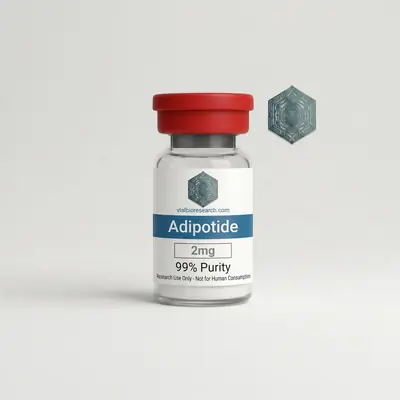
One listing gives 5 mg and 10 mg sizes, a price range of $39.99-$75.00, and purity of at least 99% by HPLC. It describes a lot-specific Certificate of Analysis as available on request.
The listed price applies to that listing and may not represent other vendors or remain current. Researchers can use these checks when comparing products:
- Match the vial label to the requested compound and lot.
- Inspect the lot-specific Certificate of Analysis.
- Check that identity and purity methods are documented.
- Confirm storage and handling instructions before use.
These checks help assess a product for research use, but a listing does not establish clinical quality or suitability. Documentation supports research evaluation; it cannot turn preclinical findings into clinical guidance.
Conclusion
Adipotide is a preclinical research approach, not an established weight-loss option. Its design investigates vascular targeting rather than direct targeting of adipocytes, while animal outcomes do not establish human use.
Researchers considering laboratory work should review the lot-specific documentation and the protocol for their own experimental setting. Research decisions should follow verified documentation and institutionally approved procedures.
FAQ
How does adipotide differ from a drug that acts directly on fat cells?
Adipotide is designed to target endothelial cells in vessels supplying white fat, rather than binding directly to adipocytes as its first target. Its proposed route uses vascular recognition and a linked payload. That design does not prove that only those cells are affected, and it does not establish a clinical effect in people.
What does prohibitin do in adipotide research?
Prohibithin is the stated binding target on endothelial cells associated with white-fat vasculature. The targeting motif is designed to recognize prohibithin on those cells, which line vessels supplying white adipose tissue. No quantitative binding-affinity value is provided, so the binding strength cannot be summarized with a specific number.
Did adipotide improve insulin resistance in humans?
No human benefit is established by the described findings. The reported efficacy observations come from animal models, including obese monkeys treated for 28 days. Those results included improved insulin resistance in that model, but they cannot establish whether people would experience the same effect, or determine a safe or effective human dose.
What kidney-related effects were observed in monkey studies?
Researchers reported changes in renal proximal tubule function in the monkey study. The changes were described as predictable and reversible at experimentally determined optimal doses. That observation is a safety signal from an animal experiment, not proof that the approach is safe for people or that kidney effects would be reversible in another setting.
How much does adipotide cost?
One product listing gives a price range of $39.99-$75.00 and offers 5 mg and 10 mg sizes. Those figures apply to that listing, not every vendor, and they may change. A price does not confirm a product’s identity, batch quality, suitability for a study, or safety for human use.
What purity should researchers expect from adipotide?
One listing reports purity of at least 99% by HPLC, but that claim is not a universal standard for every product or lot. Researchers should inspect the lot-specific Certificate of Analysis and check which identity and purity methods it documents. A stated purity result does not establish human safety or clinical quality.
Is there a standard solvent or pH for reconstituting adipotide?
No standard solvent or pH is specified in the product details described here. Researchers should follow lot-specific, product instructions and their laboratory’s validated protocol rather than assume a solvent or target pH. Storage conditions alone do not supply a stepwise mixing method or show that one procedure fits every formulation.
Compounds referenced
Every compound discussed above, with its current certificate of analysis.
More research notes
- AOD 9604 vs HGH Frag 176 191 Key Differences Explained
- BPC-157 and TB-500 Synergy: Mechanisms and Protocol Guide
- SLU-PP-332: Mechanism in Cell Models Explained
- Next-Generation Incretin Mimics: Exploring Cagrilintide and Survodutide Pathways
- Ipamorelin & CJC-1295 (DAC vs. No DAC): Pulsatile GH Release vs. Continuous Elevation in Preclinical Research
- BPC-157 and TB-500: The Molecular Synergy of Angiogenesis and Actin Upregulation
- Semaglutide vs. Tirzepatide: Comparing Mono-GLP-1 and Dual GLP-1/GIP Agonism in Laboratory Models
- Endotoxin testing: the assay that decides whether a batch is usable
- The five research categories, and what distinguishes them
- Choosing a fill size: 5 mg, 10 mg or 20 mg