
BPC-157 and TB-500 Synergy: Mechanisms and Protocol Guide
BPC-157 and TB-500 are discussed together as an experimental pairing, but evidence that the combination improves human healing is not established. If you are weighing options after an injury, this guide separates research hypotheses from demonstrated outcomes and explains what people can and cannot conclude.
You will see how proposed local repair signaling differs from cell-migration ideas, what preclinical evidence and limited human reports can support, and why no established human dose or combined protocol exists. Neither compound is FDA-approved for injury recovery, and research-use products are not for human use. No prospective human study has established a combination dose, ratio, or interaction profile.
Key Takeaways
- The proposed synergy remains a research hypothesis, not a proven human treatment.
- BPC-157 and TB-500 have different identities and evidence bases.
- Much of the mechanism research is preclinical or concerns thymosin beta-4, not TB-500 itself.
- No human study has established a combined dose, ratio, or frequency.
- Research-use-only products are not authorized for use in people or animals.
The first step is understanding what each peptide is proposed to do.
What Does BPC-157 Do in Repair Signaling?
BPC-157 research focuses on local repair conditions and associated signaling, not a proven human effect. BPC-157 is a synthetic pentadecapeptide, meaning a chain of 15 amino acids, studied mainly in cells and animals.
Reported signals do not confirm that the same mechanisms improve tissue repair in people. Research has examined vascular signaling, nitric oxide pathways, tendon-cell observations, and focal adhesion kinase signaling.
VEGFR2 and blood-vessel signaling
VEGFR2 is a vascular signaling target involved in responses linked to new blood-vessel growth. Angiogenesis means the formation of new blood vessels from existing vessels, which can affect oxygen and nutrient delivery to a repair site. Researchers have reported BPC-157-related VEGFR2 signaling in preclinical work. These observations do not establish a useful effect in human injuries.
Research also reports growth hormone receptor expression in tendon fibroblasts exposed to BPC-157. That finding concerns receptor expression in cells. It is not evidence that BPC-157 raises growth hormone in people or changes clinical healing.
Nitric oxide and focal-adhesion signaling
Nitric oxide helps regulate vessel dilation and local blood flow. BPC-157 experiments have used L-arginine to raise nitric oxide and L-NAME to block it. These are experimental controls for examining pathway responses, not ingredients in a human treatment protocol.
FAK signaling concerns how cells attach to surrounding material and move. Researchers can track these signals alongside inflammation and repair markers, but pathway activity alone does not show pain relief or restored function. Common experimental readouts include:
- VEGFR2 signaling
- Nitric oxide pathway response
- Fibroblast survival or migration
- FAK-related signaling
These measures help frame laboratory questions, not predict an individual outcome. From local signaling, the discussion turns to TB-500’s proposed role in cell movement.
How Does TB-500 Affect Actin and Cell Migration?
Actin is part of a cell’s internal structure, and changing its availability can affect how cells move. The proposed TB-500 mechanism draws on thymosin beta-4 research, but direct TB-500 evidence is much thinner.
Results involving full-length thymosin beta-4 cannot automatically be assigned to TB-500. TB-500 is a synthetic seven-amino-acid fragment of thymosin beta-4, a naturally occurring 43-amino-acid peptide.
Actin sequestration and cell movement
Thymosin beta-4 binds and sequesters monomeric actin, the individual units cells can use to build internal structures. Cells reorganize actin as they change shape and move. In some models, researchers examine whether this process supports the movement of repair cells toward damaged tissue.
Lamellipodia are broad, sheet-like cell extensions that help a cell crawl across a surface. Their formation can be studied as a measure of cell movement. It does not show that a peptide improves wound healing or injury recovery in a person.
Some research models also examine stem-cell migration toward damaged tissue. That proposed repair role is a hypothesis or model endpoint, not a demonstrated clinical result. Movement observed in a controlled model cannot establish that cells travel to an injury site in a useful way inside a person.
What TB-500 evidence can and cannot establish
Much of the cited mechanistic literature concerns thymosin beta-4 rather than the shorter TB-500 fragment. The two names refer to different molecules, so a shared biological relationship does not make their research records interchangeable.
Direct evidence for TB-500 itself is comparatively sparse. Cell migration, wound healing, and repair-cell activity may suggest questions for further study, but they do not establish an effective human use or dose. The next question is whether two different proposed mechanisms amount to meaningful synergy.
What Is BPC 157 and TB 500 Synergy?
The proposed synergy is a hypothesis that combines separate, potentially complementary research ideas. BPC-157 may affect the local repair environment, while thymosin beta-4-related actin signaling may affect cell movement across tissues. Neither role is a proven human benefit.
Combining plausible mechanisms does not demonstrate that the pair works better than either peptide alone. No prospective human study has tested a defined combination dose, ratio, or interaction profile.
The proposed local and broader repair roles
Supporters of the idea often describe one component as influencing conditions near an injury site and the other as supporting movement by cells involved in repair. That framing is a research rationale. It does not establish that both compounds reach a useful site, remain active together, or produce a better result.
A BPC-157 and TB-500 blend is a marketing description, not a standardized research formulation. Products sold under that label may vary in their contents, ratio, and stated identity. The name alone cannot show that a vial contains the same materials used in a particular experiment.
Why complementary mechanisms do not prove a better outcome
Synergy is a measurable claim: the combination would need to outperform each compound alone under controlled conditions. Researchers would also need to assess safety and interactions. A pair of separate theories does not answer either question.
The term “stack” has no standardized composition, ratio, or clinical definition. Without a defined formulation and controlled comparison, claims about combined healing remain uncertain. The theory is useful for framing research, but the evidence must be judged on its own terms.
That leads from a proposed mechanism to what the available evidence can actually show.
Are BPC-157 and TB-500 the Same Kind of Peptide?
The difference in molecule size shows that these compounds do not share the same research history. BPC-157 is a synthetic 15-amino-acid peptide, while TB-500 is a seven-amino-acid fragment related to 43-amino-acid thymosin beta-4. Those are distinct identities.
A finding about full-length thymosin beta-4 is not automatically a finding about TB-500. The length and structure of a peptide can affect how it behaves, so the name on a product or paper matters.
BPC-157 came from research on gastric protection and was first described between 1991 and 1993. It was developed from gastric-protein research. Its history differs from the broader work on thymosin beta-4, which is naturally occurring in the body.
TB-500 refers to a synthetic seven-amino-acid fragment, not the entire thymosin beta-4 molecule. Studies of the 43-amino-acid peptide may help researchers form hypotheses about the fragment, but they cannot establish that TB-500 has the same effects or safety profile.
Peptide names in a paper identify what researchers studied; a product label does not provide the same assurance. The label alone does not establish identity, purity, sterility, or consistency from vial to vial. Purity is only one part of product quality.
These distinctions matter when comparing claims. A study of one peptide, tissue, or route cannot stand in for another. Separating molecule identity from evidence strength makes the research record easier to assess.
The evidence comparison begins by distinguishing what has been tested in cells, animals, and people.
What Does the Evidence Show Across Lab and Human Studies?
The evidence hierarchy is clear: laboratory and animal findings are not equivalent to controlled human results. BPC-157 has more preclinical research than direct TB-500 research, but neither record proves the proposed combination works in people.
No controlled musculoskeletal trial has tested the pair, and no prospective combination trial has established its benefit. The table separates evidence by research setting.
| Evidence area | BPC-157 | TB-500 or thymosin beta-4 |
|---|---|---|
| Cell and laboratory | Cultured tendon-cell and other laboratory work exists. | Much work concerns thymosin beta-4, not direct TB-500 testing. |
| Animal repair models | Multiple animal repair models have been reported. | Thymosin beta-4 models exist; TB-500-specific evidence is sparse. |
| Human evidence | Human reports are limited. | No prospective combination trial or controlled musculoskeletal trial of the pair. |
The table does not rate study quality or predict clinical value. Cell experiments can identify possible activity, and animal models can test outcomes in a whole organism. Neither can show that a product is safe and effective for a person with a particular injury.
BPC-157 and TB-500 reviews may summarize these findings, but a review cannot turn preclinical results into clinical proof. Readers should check which exact molecule, model, and outcome each claim describes.
The evidence supports research questions, not a standard injury protocol. The next comparison narrows to tendon and ligament models, which are often linked to connective-tissue repair.
What Do Tendon and Ligament Models Actually Measure?
A rat tendon or ligament injury model does not reproduce the full course of a human injury. It can measure defined changes in a controlled setting, but not a person’s recovery in daily life.
Model outcomes do not establish that a treatment restores human function or shortens recovery. BPC-157 research includes transected rat Achilles tendon models and tendon-to-bone healing work.
| Model or tissue | Reported research focus | What it cannot establish |
|---|---|---|
| Rat Achilles tendon | Transection and tendon-to-bone healing models | Human pain relief, return to activity, or safe dosing |
| Rat ligament injury | A 2010 study reported improved ligament healing with BPC-157 | Benefit for human ligament injuries or the combined stack |
| Cultured tendon fibroblasts | Fibroblast survival, outgrowth, or migration | Whole-body healing or restored human function |
Researchers can track experimental markers such as fibroblast activity, collagen organization, vascular signaling, and functional recovery scores. These are examples of measures used across research, not a claim that every marker appeared in every model.
A reported change in collagen structure or cell activity is not the same as a patient’s return to work, sport, or usual movement. Animal studies also differ in injury method and observation conditions, limiting comparisons between them.
Thymosin beta-4 ligament research is limited, and findings involving that molecule should not be relabeled as direct TB-500 results. These connective-tissue models are only one part of the preclinical record.
Other research areas include wound, muscle, and gut models, each with its own limits.
What Do Wound, Gut, and Muscle Models Add?
Evidence from skin, gut, or muscle models cannot automatically be carried over to tendon recovery. Each tissue has different structure and repair demands, so the model matters.
Findings in one tissue do not establish a human exercise-recovery benefit. The research histories also differ between BPC-157 and thymosin beta-4.
| Research area | Relevant model or evidence | Limit |
|---|---|---|
| Wound | Thymosin beta-4 research includes rodent skin, burn, and diabetic wound models; human venous-ulcer trials tested thymosin beta-4. | Those trials tested thymosin beta-4, not TB-500, and do not prove tendon benefit. |
| Gut and mucosal tissue | BPC-157 research includes gastric lesion, colitis, and fistula models. | Gut and mucosal outcomes do not establish musculoskeletal recovery. |
| Muscle | BPC-157 research includes rat crush and quadriceps models. | Direct thymosin beta-4 muscle-injury evidence is thin. |
Thymosin beta-4 wound-healing research includes several rodent settings. Human venous-ulcer trials studied the full-length molecule, not the TB-500 fragment. That distinction is important when a product claim cites a wound study to support a different compound or use.
BPC-157 gastric lesion, colitis, and fistula models reflect a separate research history. A result involving gut tissue cannot establish how the compound performs in a tendon, ligament, or muscle injury.
Muscle models also remain preclinical evidence. None of these areas establishes a human benefit for exercise recovery, training soreness, or return to sport. The next question is what the small amount of direct human evidence can show.
What Have Human Studies Reported About the Combination?
Only four patients received BPC-157 with TB4 in a 2021 retrospective knee chart review, and three reported improvement. That subgroup is very small, and the chart review does not establish a proven TB-500 combination effect.
The report described TB4, not a controlled trial of TB-500. It covered 17 patients receiving intra-articular peptide injections: 12 received BPC-157 alone, and 11 reported significant improvement.
The review had no control group or blinding. It did not use validated WOMAC or KOOS measures, which assess knee symptoms and function. Follow-up relied on telephone self-ratings months later, leaving the results vulnerable to recall and reporting limits.
A retrospective chart review records care that has already happened. It cannot reliably separate a treatment effect from natural recovery, other care, expectations, or differences between patients. The small combined subgroup also makes its reported outcome especially uncertain.
A separate BPC-157 bladder procedure involved 12 women with interstitial cystitis. That was not a study of the combination or of musculoskeletal healing. It cannot answer whether the pair helps a tendon, ligament, or other injury.
Prospective testing would need a defined product, comparison groups, planned outcome measures, and follow-up. These limited observations cannot establish how quickly a reader should expect a result.
What Benefits and Recovery Timelines Are Actually Established?
No reliable human timeline for the combination has been established. Proposed BPC-157, TB-500 benefits remain hypotheses informed by model findings, not established clinical outcomes.
No published human study has tested either compound for training load, soreness, return-to-play, or exercise recovery. Animal observation periods range from days to several weeks, but they do not predict when a person might feel a change.
Proposed benefits versus demonstrated outcomes
Claims about healing, less pain, reduced inflammation, or faster recovery may draw on cell or animal work. Those findings can suggest topics for further research. They cannot establish that people will experience the same effects or return to activity sooner.
A recovery timeline depends on the injury, its severity, and the care being studied. Because controlled human results are missing, a number of days or weeks would be speculation. Personal anecdotes also cannot set a reliable expectation for other people.
Oral use and routes studied
Searches for BPC-157, TB-500 oral use do not change the evidence gap. There is no basis for a validated oral protocol for the combination. Route findings from one peptide cannot establish efficacy for the other.
Routes tested in one model or study do not transfer automatically to a different compound, route, or injury. Oral, local, or injected use would each need direct evidence. Without that evidence, neither route nor onset can be presented as a proven option.
The next distinction is between animal-study dosing and a human protocol.
What Dosing Protocols Exist in Research?
No standardized human dose exists for either compound or their combination. Published dosing protocols describe specific research experiments, not human instructions.
Animal schedules cannot be converted directly into a safe or effective human regimen. Rodent BPC-157 studies use model-specific microgram-per-kilogram levels, with nanogram levels in some comparative experiments.
Thymosin beta-4 studies use different units and methods. Recombinant thymosin beta-4 given intravenously in a Phase I study is not a TB-500 protocol. Animal studies include daily administration, single doses, and varied schedules over several days to several weeks.
These differences prevent a simple conversion to a schedule for a person. No frequency comparison establishes an optimal human schedule. In particular, no evidence-based BPC-157 + TB-500 blend dosage per week, BPC-157 and TB-500 dosage for injury, or BPC-157 + TB-500 blend dosage and frequency is established.
Animal schedules cannot be converted directly for these reasons:
- Species and model differences
- Distinct molecules
- Route and concentration differences
- No established human therapeutic window
- No established combination ratio
A number from a rodent study cannot serve as a human starting point. Studies differ in the injury model, route, formulation, and observation period, so their figures do not define a general protocol.
Even handling and mixing a vial requires product-specific information that a general protocol cannot supply.
How Should Reconstitution Be Approached Safely?
The vial label and validated instructions, not a generic online ratio, determine whether and how material can be reconstituted. There is no universal volume for BPC-157 or TB-500.
Research-use-only material is not for human or veterinary use. Reconstitution guidance does not make an unapproved product suitable or safe for injection.
Check the product instructions before mixing
The amount of diluent depends on the labeled vial content and product-specific instructions. A vial’s contents and the intended research method can differ across products. If validated instructions do not specify the correct diluent and volume, a general online recipe cannot fill that gap.
Bacteriostatic water is not automatically the right diluent for every product. Use it only when validated product instructions specify it. A solution that looks clear does not prove the material is correctly prepared, sterile, or suitable for a particular use.
Understand concentration without treating it as a dose
Concentration is calculated as labeled mass divided by diluent volume. That calculation describes the amount of material per volume; it does not establish a dose, frequency, or safe injection amount.
Before any authorized research preparation, check:
- Verify the exact compound and vial label.
- Confirm the diluent and volume in validated instructions.
- Use aseptic handling in an authorized research setting.
- Discard material if identity, sterility, or handling is uncertain.
A research-use-only label means the material is not for human or veterinary use, regardless of how a seller describes it. Mixing decisions lead to a separate question: storage and product quality.
How Should Vials Be Stored and Quality Checked?
A claimed storage duration is useful only if validated for the exact product and conditions. Unreconstituted material and a reconstituted solution may require different handling, so one rule cannot cover every vial.
There is no universal validated stability period for these products. Follow validated, product-specific handling and storage instructions rather than assuming a shelf life.
Online claims about room-temperature powder storage or a four-to-six-week refrigerated stability period are not established universal facts. Stability can depend on the exact material, formulation, container, and conditions. A duration without those details does not show that a product remains usable.
Quality has several separate parts: identity, purity, sterility, synthesis byproducts, and contamination. A vial can meet one measure and still have problems with another. A label or certificate does not, by itself, resolve every concern.
Third-party analytical testing may assess identity and purity. Those tests alone do not establish sterility, clinical suitability, or human safety. Testing also cannot show that a product will have a desired effect in a person.
Unreconstituted powder and prepared solution should not be treated as interchangeable for storage. Conditions must come from validated instructions for that exact product. The absence of a general stability period makes unsupported shelf-life claims risky.
Product handling uncertainty is distinct from the compounds’ own biological risks. The next issue is what safety concerns remain known or unknown.
What Side Effects and Safety Uncertainties Matter?
There is no complete controlled human safety profile for this combination. Anecdotal accounts and clinical observations include injection-site pain, redness or swelling, headache, fatigue, and nausea, but these reports are not controlled estimates.
Those side effects have not been quantified in controlled musculoskeletal trials. Their frequency and severity for the combination remain uncertain.
Reported reactions and limits of the data
Human interaction risks, long-term exposure, immune responses, and potential cell-proliferative effects remain uncertain. Limited reports cannot show how often a reaction occurs or whether a risk changes with longer use.
If you are discussing an experimental product with a clinician, raise these warning categories:
- Injection reactions
- New or worsening symptoms
- Medication or condition interactions
- Uncertain long-term exposure
Liver, hormones, and longer-term unknowns
Asked whether BPC-157 is hard on your liver, the answer is that available information does not establish a human liver-risk profile. That gap does not mean liver risk is ruled out. Controlled evidence is not sufficient to define risk for people.
There is no established human evidence that BPC-157 changes testosterone. Growth hormone receptor expression observed in tendon cells does not show that the peptide changes growth hormone or testosterone in people.
People with ongoing conditions or medicines need individualized advice. Do not treat the absence of a documented reaction as proof that an interaction cannot happen. Product quality concerns and biological risks are separate questions.
Before considering use, weigh the regulatory status as well as these safety uncertainties.
What Rules Apply to Use and Sport?
Neither compound is FDA-approved for injury recovery. U.S. readers should distinguish regulatory review, sport rules, and a clinic’s willingness to offer a service; they are not the same thing.
Research-use-only products are not authorized for human or veterinary use. A clinic offering a service does not mean the FDA has approved the compound for that use.
| Date | Regulatory or sport action | Practical significance |
|---|---|---|
| 2022 | BPC-157 named on the WADA Prohibited List under S0 Unapproved Substances | Relevant to athletes subject to WADA rules |
| 2023 | FDA review of both compounds as bulk drug substances that may present significant safety risks | Review is not FDA approval |
| 2026 | FDA convened an advisory committee on both compounds | Neither compound thereby became approved for injury treatment |
The WADA listing applies to athletes subject to those rules. It does not describe whether a compound is an approved medical treatment. Athletes should consider the rules that govern their sport before using a prohibited substance.
In 2023, the FDA placed both compounds under review as bulk drug substances that may present significant safety risks. The FDA convened an advisory committee on both compounds in 2026. Neither action constitutes approval for injury treatment.
Regulatory status does not answer whether a product is accurately labeled or safe. It does clarify that a research-use label is not authorization for human or veterinary use. A clinic’s decision to offer a service is separate from FDA approval.
The practical next step is a decision framework that prioritizes diagnosis and qualified medical advice over an online stack schedule.
How Can You Assess a Claimed Stack Protocol?
A tendon claim based on a rodent study is not a validated human protocol. The model may point to a research question, but it cannot set human treatment.
Match every protocol claim to the exact molecule, tissue, route, and type of evidence behind it. Use these checks before discussing a claim with a qualified healthcare professional.
Match the claim to the evidence
Ask what evidence supports the claim and whether it concerns the compound named on the label. A report about thymosin beta-4 is not automatically evidence about TB-500. A result in skin or gut tissue does not establish an effect in a tendon.
Work through this checklist:
- Identify the exact substance and whether evidence concerns TB-500 or thymosin beta-4.
- Ask whether the claim rests on cell, animal, or controlled human data.
- Confirm the proposed use is not inferred from a different tissue or route.
- Ask about diagnosis, standard care, medication interactions, and follow-up.
- Avoid products labeled for research use if the intended use is in a person.
Get injury-specific medical advice
A persistent, severe, or function-limiting injury needs clinical assessment rather than self-treatment. A clinician can evaluate what tissue is involved, whether further testing is needed, and what established care fits the injury.
Bring specific questions about the evidence, possible interactions, and follow-up. Avoid treating an online protocol or a seller’s claim as a substitute for an assessment. No product source or general schedule can resolve those individual questions.
The practical next step is a medical conversation, not an improvised injection plan.
Conclusion
Complementary mechanisms are a rationale for research, not proof of clinical synergy. The proposed pairing of local signaling and cell migration remains a hypothesis, and no standardized human dose or proven combined benefit exists.
For an injury, discuss the diagnosis, the evidence behind any proposed product, and established care options with a qualified healthcare professional. That injury-specific conversation is a safer next step than building a self-directed stack.
Compounds referenced
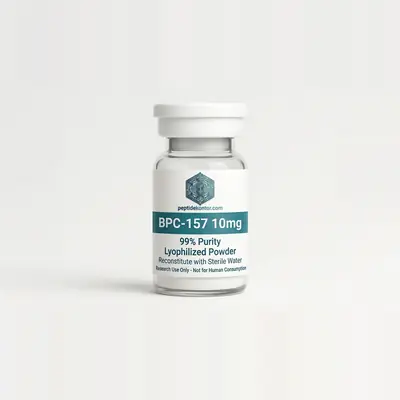
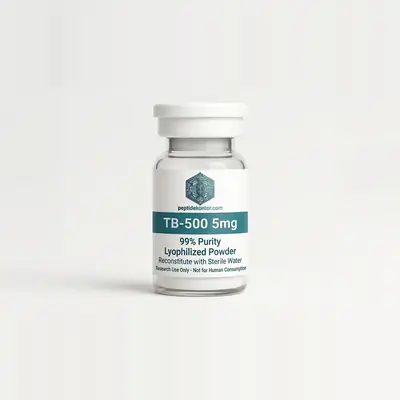
Every compound discussed above, with its current certificate of analysis.
More research notes
- AOD 9604 vs HGH Frag 176 191 Key Differences Explained
- Adipotide: Mechanisms of Vascular Targeted Adipose Disruption
- SLU-PP-332: Mechanism in Cell Models Explained
- Next-Generation Incretin Mimics: Exploring Cagrilintide and Survodutide Pathways
- Ipamorelin & CJC-1295 (DAC vs. No DAC): Pulsatile GH Release vs. Continuous Elevation in Preclinical Research
- BPC-157 and TB-500: The Molecular Synergy of Angiogenesis and Actin Upregulation
- Semaglutide vs. Tirzepatide: Comparing Mono-GLP-1 and Dual GLP-1/GIP Agonism in Laboratory Models
- Endotoxin testing: the assay that decides whether a batch is usable
- Storage, reconstitution and cold chain: keeping peptides stable
- The five research categories, and what distinguishes them
- Choosing a fill size: 5 mg, 10 mg or 20 mg